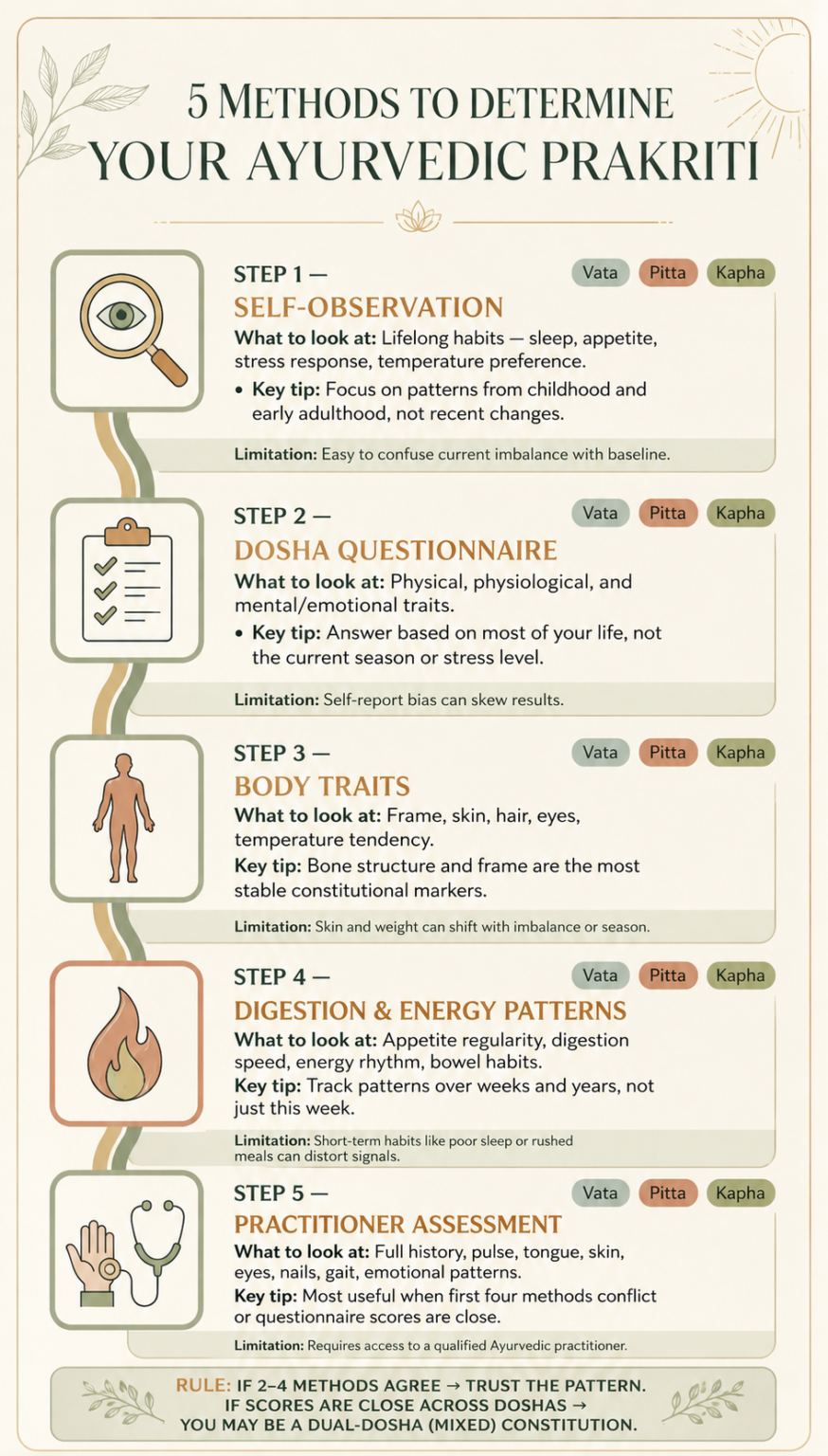
How to Determine Your Prakriti:
5 Ayurvedic Methods for Finding Your True Baseline
A hard month can make almost anyone feel like a different person, wired and restless, or heavy and slow to get moving. Ayurveda has a word for that shift. It also has a separate word for what sits underneath it, the part that doesn’t change nearly as easily.
It’s easy to take a quiz on a rough week and walk away thinking that’s simply who you are. A single questionnaire, answered once, tends to capture a moment rather than a lifetime.
Ayurveda draws a clear line between the two. Prakriti is the constitution you were born with. Vikriti is the state you’re in right now, shaped by stress, season, sleep, and everything else moving through your life this month. Knowing the difference changes how you read almost everything else about your body.
In this guide, you’ll discover:
Why Prakriti and Vikriti aren’t the same question
Five methods Ayurveda uses to find a baseline, and where each one falls short on its own
A dosha-by-dosha look at the physical traits that tend to stay stable
How to put all five methods together for a clearer read
Prakriti and Vikriti: The Two Questions Ayurveda Asks
Prakriti asks: what has been true for most of your life?
Vikriti asks: what’s true for you right now? The gap between the two answers is often the clearest signal of how out of balance something currently is.
This distinction is also why no single method below is meant to stand alone. A dosha questionnaire taken during a stressful week, a symptom that showed up last month, a trait that shifted with the season, any one of these can look like Prakriti when it’s really just Vikriti passing through. The five methods that follow work best read together, each one catching something the others tend to miss.
Methods 1 & 2: Self-Observation and the Dosha Questionnaire
Self-observation starts with a simple question: what has been true for most of your life, not just what’s going on today. Go back to childhood and early adulthood. Were you naturally lean with a lighter frame, or did you tend toward a heavier, more solid build? Did you run cold most of your life, or were you often the one getting too warm while everyone else felt fine?
Look for patterns that tend to stick: body build, skin, appetite, sleep, temperature preference, and your usual response to stress.
Vata types often lean toward anxiety paired with creativity.
Pitta types often lean toward ambition paired with irritability.
Kapha types often lean toward steadiness and calm.
Light, broken sleep for most of your life points toward Vata. Deep, heavy sleep with mornings that are hard to shake off leans Kapha.
The trap to avoid is confusing a recent imbalance with your actual baseline. That’s where a questionnaire becomes useful as a second check, not a first answer. Answer based on most of your life, not the current season or how stressed the last few weeks have been. Questionnaires make a solid starting point, but self-report bias is real, and a short-term change can easily get mistaken for a lifelong trait. A single strong answer on one question rarely tells the whole story. Look instead for a cluster across physical, mental, and digestive traits. If your scores land close to each other across two doshas, that’s not a flaw in the test; it often means you have a genuinely mixed constitution.
Method 3: What Your Body Traits Reveal
Body traits work best as a gut-check against what self-observation and the questionnaire already suggested. Bone structure and frame tend to stay stable across a lifetime, which makes them a steadier marker than skin or weight, both of which shift more easily with season or imbalance.
Vata tends toward a thin, light, bony build; dry, thin, cool skin; dry or frizzy hair; small, active eyes; and a temperature preference that always runs cold. Weight is often hard to gain and easy to lose.
Pitta tends toward a medium, balanced build; warm skin prone to redness; fine hair prone to early graying; medium, piercing eyes that are sensitive to light; and a temperature that runs warm, with a dislike of heat. Weight tends to move with effort, gained and lost in roughly equal measure.
Kapha tends toward a broad, sturdy, large-boned build; thick, oily, smooth skin; thick, oily, wavy hair; large, calm, moist eyes; and a cool temperature paired with a dislike of cold, damp weather. Weight is often easy to gain and harder to lose.
A tall but broad frame can suggest dual dominance. Restlessness versus steadiness in the eyes is often the clearest single differentiator across the three. And skin, more than any other trait here, tends to reflect current imbalance as much as constitution, so it’s worth weighing less heavily than frame or eye quality.
Method 4: Digestion and Daily Energy as a Baseline Clue
Digestion is governed by agni, and it tends to line up closely with constitution.
Vata digestion is irregular, appetite can swing from one day to the next, and bloating or gas shows up often.
Pitta digestion runs sharp, missing a meal brings irritability fast, and heartburn tends to recur.
Kapha digestion is slow, hunger runs low, and meals can leave a heavy, sluggish feeling behind.
Energy tends to follow the same pattern.
Vata energy arrives in bursts and drops off quickly.
Pitta energy is intense and steady.
Kapha energy starts slow but carries real staying power once it gets going.
Daily habits can throw all of this off temporarily. A rushed lunch, a bad night of sleep, too many hours sitting still, any of these can make almost anyone feel a little off. That’s exactly why digestion and energy are worth tracking over years, not the past week alone.
Method 5: When a Practitioner Assessment Helps
When the first four methods point in different directions, a practitioner assessment can help sort baseline Prakriti from current Vikriti. This step is most useful when questionnaire scores land close together, when symptoms keep lingering, or when stress and diet may be muddying the picture.
A practitioner typically takes a detailed history, appetite, digestion, sleep, energy, emotional patterns, and how each has shifted across seasons and over time. In-person signs matter too: body shape, voice, gait, skin, and general demeanor. Traditional tools often include pulse and tongue observation, alongside a closer look at skin, eyes, and nails. The goal isn’t to fixate on one symptom. It’s to read the whole person and separate a long-term baseline from whatever is currently passing through.
A gentle note: this article is meant to help you understand yourself, not to diagnose or treat a health condition. Practitioner assessment, including pulse and tongue observation, is best done with a qualified Ayurvedic practitioner, and any persistent health concern is worth bringing to a healthcare provider.
Putting the Five Methods Together
Used in order, the five methods move from self-checking toward outside confirmation. Start with self-observation of lifelong patterns, how you naturally eat, sleep, and move outside of unusual stress. Take a dosha questionnaire next, treating the result as a starting point rather than a final answer. Compare that against stable physical markers like frame, skin, and eye quality. Then track digestion and daily energy for several weeks to see which pattern shows up most consistently. If the picture is still unclear after all four, a practitioner consultation is the natural next step.
A simple rule tends to hold: if two to four methods point the same direction, that pattern is usually more reliable than any single strong trait on its own. And if the results land close across doshas, that’s often a sign of a genuinely mixed constitution, not a failed test.
The clearest read never comes from one isolated sign. It comes from a pattern that keeps showing up, across years, across seasons, across the ordinary ups and downs of a life.
Mixed constitutions make single-sign reading messy on purpose, in a sense, because most people genuinely are a blend. A questionnaire result or one physical trait might be telling you more about this month than about your baseline. That’s the whole reason these five methods are meant to be read together rather than one at a time.
Over time, Prakriti tends to become easier to see, not through any single test, but through the patterns that keep repeating around food, season, stress, and daily rhythm. That kind of pattern-based understanding tends to make food, routine, and lifestyle choices feel steadier, less like guesswork and more like listening to something that was there all along.
Get to Know Your Constitution, Not Just Your Symptoms
Five methods can point you toward a baseline, but living in alignment with it is its own practice. The Dosha Protocol gives you 21 mornings of type-specific Ayurvedic practice, built around your constitution, just five minutes a day.