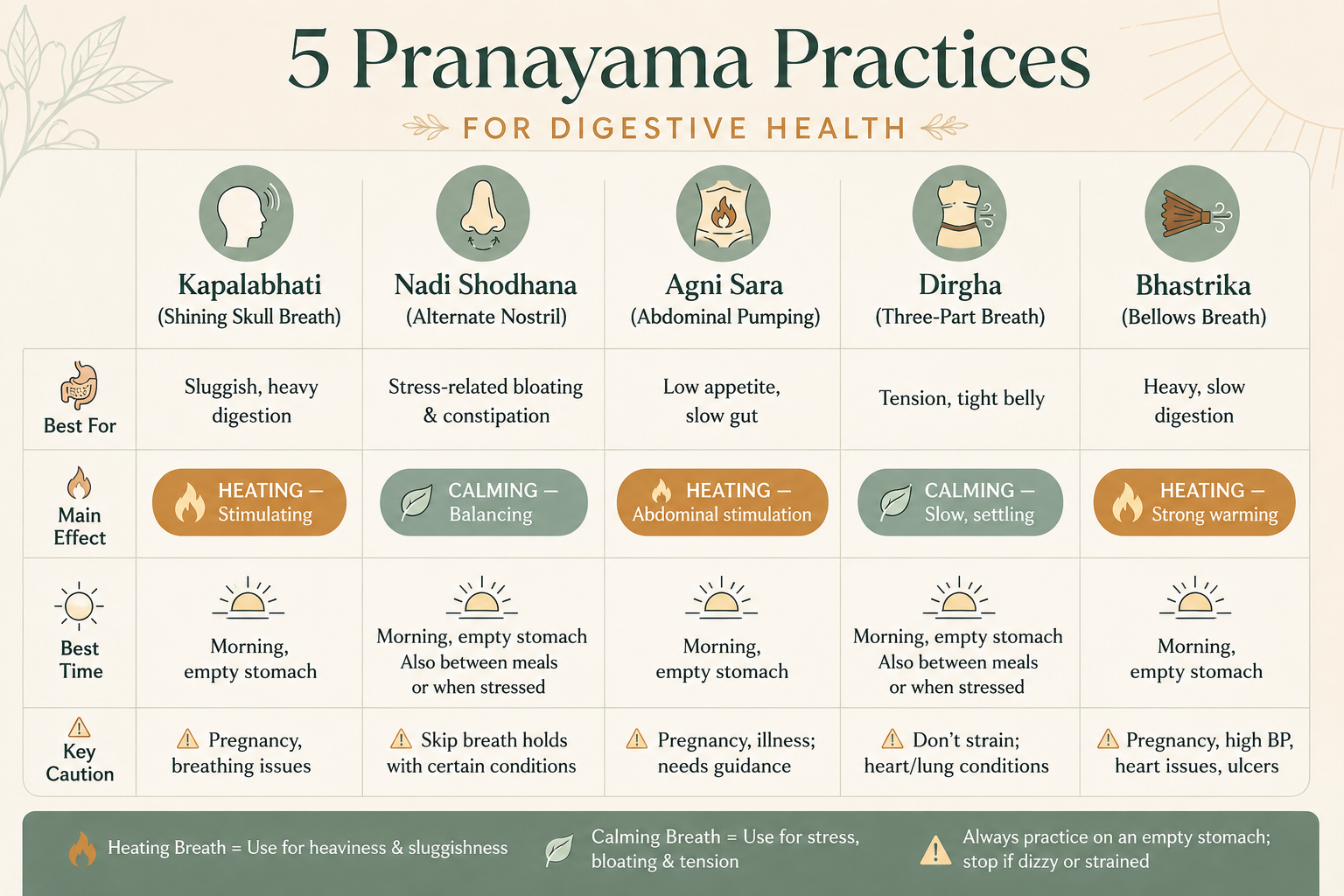
5 Pranayama Practices for Digestive Health
(and How Ayurveda Uses Breath to Support Agni)
There’s a moment, most days, when the breath goes unnoticed entirely — shallow, quick, tucked somewhere behind whatever else is happening. And yet in Ayurveda, that same breath is considered one of the quietest ways the body either supports its digestion or works against it.
A heavy, sluggish afternoon and a tight, anxious stomach can look like opposite problems. Often, they’re not. Both trace back to the same place: an agni, or digestive fire, that isn’t being met with the rhythm it needs.
Ayurveda has never treated breath as separate from digestion. Long before modern science mapped the vagus nerve and its ties to “rest and digest” states, pranayama was already being used to calm an overactive gut, coax a sluggish one back to life, and settle the mind enough for either to happen.
In this guide, you’ll discover:
Why Ayurveda ties breath so closely to digestive fire
Five pranayama practices — some warming, some calming — and which digestive pattern each one supports
How to build them into a simple daily rhythm
When to slow down or skip a practice altogether
How Breath Supports Agni
Ayurveda describes digestion through agni, the fire that transforms food into nourishment. Like any fire, agni needs the right conditions to stay steady — not smothered, not left to burn unchecked.
Breath is one of the more overlooked ways of tending it. The diaphragm’s movement gives the abdominal organs a gentle, rhythmic massage with every inhale and exhale. Ayurveda attributes much of this to Samana Vata, the current governing the mid-abdomen and the steady, even movement that keeps digestion from feeling stagnant. Apana Vata, seated lower in the body, governs elimination — and tends to follow wherever Samana Vata leads.
When stress pulls the body out of balance, that rhythm is often the first thing to go. Modern research on the vagus nerve echoes something Ayurveda has said for centuries: a nervous system stuck in alert mode rarely digests well. Slow, intentional breathing is one of the more direct ways back to a calmer state — and calmer state tends to mean steadier digestion.
Not every breath serves the same purpose, though. Some practices are warming and stimulating, better suited to a heavy, slow-moving digestion. Others are cooling and settling, better suited to a stomach that’s tight with stress. Knowing which is which matters more than doing all five at once.
The Five Practices
Kapalabhati — Shining Skull Breath
Kapalabhati uses sharp, rhythmic exhales to build heat quickly, making it one of the more energizing practices here. In Ayurveda, it’s considered useful for the kind of heaviness and sluggishness associated with excess Kapha — a digestion that feels dull rather than sluggish from a single meal.
It’s traditionally practiced in the morning, often after movement or yoga, always on an empty stomach. Because the technique is forceful by nature (and closer to a cleansing kriya than a gentle pranayama), it isn’t for everyone — pregnancy and any respiratory condition are reasons to skip it, or to only attempt it with guidance.
Nadi Shodhana — Alternate Nostril Breathing
Where Kapalabhati stimulates, Nadi Shodhana settles. This slower, alternating breath is traditionally used to balance the body’s two primary energy channels and, in doing so, calm Prana Vata — the current most closely tied to the mind’s state. A quieter Prana Vata tends to support a quieter Apana Vata, which is often where stress-related bloating or irregularity begins to ease.
Best practiced on an empty stomach — morning, or between meals if stress is showing up as digestive discomfort during the day. Give it five minutes to start, working up to ten or fifteen over time. The breath should stay smooth and unforced; if it starts to sound labored, that’s a sign to ease off. Anyone managing high blood pressure, heart conditions, pregnancy past the first trimester, or significant congestion should skip any breath retention and keep the practice gentle.
Agni Sara — The Fire Wash
Agni Sara takes its name directly from what it’s meant to support: agni itself. Fast, rhythmic pumping of the abdominal muscles is used here to wake up a digestion that’s gone quiet — low appetite, food that seems to sit rather than move.
Like Kapalabhati, this is technically a kriya rather than a classic pranayama, and it’s considered an advanced practice — one best learned from an experienced teacher rather than picked up from a description alone. It’s done in the morning, on a fully empty stomach, after using the bathroom. It should never be forced, and pregnancy or acute illness are clear reasons to leave it for another time.
Dirgha — Three-Part Breath
After three more active practices, Dirgha offers something gentler: a slow breath that fills the belly, then the ribs, then the chest, followed by a full, unhurried exhale. Where Vata governs movement throughout the body — including the movement of elimination — a breath this deliberate gives Prana Vata and Apana Vata room to settle back into rhythm.
It fits naturally in the early morning, after a bowel movement and before breakfast, or in any stressful moment when the belly feels tight. The instruction is simple: keep it quiet, keep it unforced, and if lightheadedness creeps in, pause and return to normal breathing before continuing more slowly. Anyone with high blood pressure, a heart condition, or a respiratory condition should check with a healthcare provider before beginning, and pregnancy calls for avoiding deep, forceful variations.
Bhastrika — Bellows Breath
The most heating of the five, Bhastrika pairs fast, forceful inhales with equally forceful exhales to build warmth quickly. Ayurveda ties it to the same Kapha-heavy sluggishness Kapalabhati addresses, though Bhastrika tends to feel stronger and more intense in practice.
It belongs in the morning, on an empty stomach, and is worth easing into — ten to fifteen breaths per round, three to five rounds, with rest in between. This one carries the longest list of cautions: skip it during pregnancy, and check with a doctor first if high blood pressure, heart disease, a hernia, or gastric ulcers are part of the picture. Anyone with a naturally warm, Pitta-leaning constitution may find more benefit from a slower, gentler version than the full-force original.
A Simple Daily Rhythm
None of these five need to happen at once. A more natural rhythm might look like this: something warming and active in the morning — Kapalabhati, Bhastrika, or Agni Sara — followed by ten or fifteen quiet minutes before breakfast arrives. Something gentler, like Dirgha, before a midday meal, easing the nervous system before food enters the picture at all. And something calming, like Nadi Shodhana, as the evening winds down, letting Vata settle ahead of rest.
The choice doesn’t need to be complicated. A heavy, slow digestion asks for warmth. A tight, restless one asks for calm. Most days will make it fairly clear which is needed.
A gentle note: pranayama can be a meaningful support for digestion, but it isn’t a substitute for medical care. If digestive symptoms are persistent, severe, or come with other concerning signs, please consult a healthcare provider. And if pregnancy, high blood pressure, heart disease, or a respiratory condition are part of your picture, check with a doctor before beginning any new breathing practice — several of the practices above carry specific cautions worth taking seriously.
Coming Back to the Breath
Digestion has never been only about what’s on the plate. It’s shaped just as much by what happens between meals — how the nervous system holds itself, how the breath moves, how much room the body is given to actually rest before being asked to work again.
None of these five practices demand much. A few quiet minutes, an empty stomach, a willingness to notice what heaviness or tightness actually feel like in the body. What they offer in return is something Ayurveda has trusted for a very long time: that agni tends to burn more evenly in a body that has learned, even briefly, how to breathe like it has nowhere else to be.
This week’s practices work on the nervous system side of digestion — but agni responds to a fuller picture: purification, dosha balance, and rejuvenation working together. The 10-Day Ayurvedic Detox Journey guides you through Ayurveda’s three-part approach to resetting digestion, from gut health to mental clarity to energy levels.