Clearing the Mind Each Morning: The Ayurvedic Practice of Nasya
There is a certain kind of clarity that doesn’t come from doing more, but from gently removing what has been quietly accumulating.
In Ayurveda, we often speak about digestion, cleansing, and balance in relation to the gut. But there is another gateway—one that is just as important, and often overlooked.
The head.
The senses.
The breath.
The subtle pathways that influence how we think, feel, and perceive the world.
Nasya is one of the simplest ways Ayurveda works with this space. Not as a dramatic intervention, but as a quiet daily ritual that helps the body stay clear before imbalance has the chance to take hold.
What Nasya Is Really Doing
Nasya involves the application of herbal oil into the nostrils, but its effect goes far beyond the nasal passages.
In Ayurvedic understanding, the nose is the doorway to Prana—the life force that governs the mind, the nervous system, and the clarity of perception.
When this pathway is clear:
breathing feels effortless
the senses are sharp
the mind feels steady and awake
When it is obstructed:
heaviness begins to settle
thinking becomes dull or scattered
congestion—physical or mental—starts to build
Nasya works gently at this interface.
Not forcing anything out, but softening, loosening, and guiding what no longer needs to remain.
The Dual Action: Clearing and Calming
Traditionally, Nasya is understood through two complementary actions:
Shodhana (clearing): helping remove excess accumulation, particularly Kapha, from the head and sinus region
Shamana (pacifying): soothing and stabilizing the tissues and nervous system
This is what makes the practice feel both cleansing and grounding at the same time.
It does not leave you depleted.
It leaves you clear.
The Benefits You Begin to Notice
With consistent use, Nasya tends to create changes that are subtle at first, then unmistakable.
Clearer Breathing
As the nasal passages are lubricated and gently cleared, breathing becomes smoother and more natural, especially in environments that are dry, polluted, or seasonally aggravating.
Mental Clarity and Focus
Because of the close relationship between the nasal passages and the brain, Nasya has a direct influence on cognitive function. Over time, many people notice reduced brain fog, improved concentration, and a greater sense of alert calm.
Emotional Steadiness
Nasya works closely with Prana Vayu, the aspect of energy that governs the mind and emotional regulation. When this becomes balanced, there is often a natural reduction in anxiety, reactivity, and mental restlessness.
Better Sleep
When practiced regularly, especially in the evening for those who need it, it can help the mind settle more easily, making it easier to fall asleep and wake feeling restored.
Choosing the Right Oil
For most people, a classical formula such as Anu Thailam works beautifully for daily use because it is designed to balance all three doshas gently.
If you are working more specifically:
Vata: slightly warming, grounding oils (such as sesame-based formulations)
Pitta: cooling options like ghee or coconut-based oils
Kapha: lighter oils infused with more stimulating herbs
For short-term or more targeted support, stronger formulations like Shadbindu Thailam may be used—but typically not as a long-term daily practice.
When to Practice Nasya
Morning is traditionally considered the best time.
After waking, once the mouth and tongue are cleansed and before food, the body is naturally receptive. The pathways are open, and the mind has not yet fully engaged with the day.
At this time, Nasya helps set the tone:
clearer breathing
steadier awareness
a sense of lightness in the head
For those experiencing stress or difficulty unwinding, a second, lighter application in the evening can also be supportive.
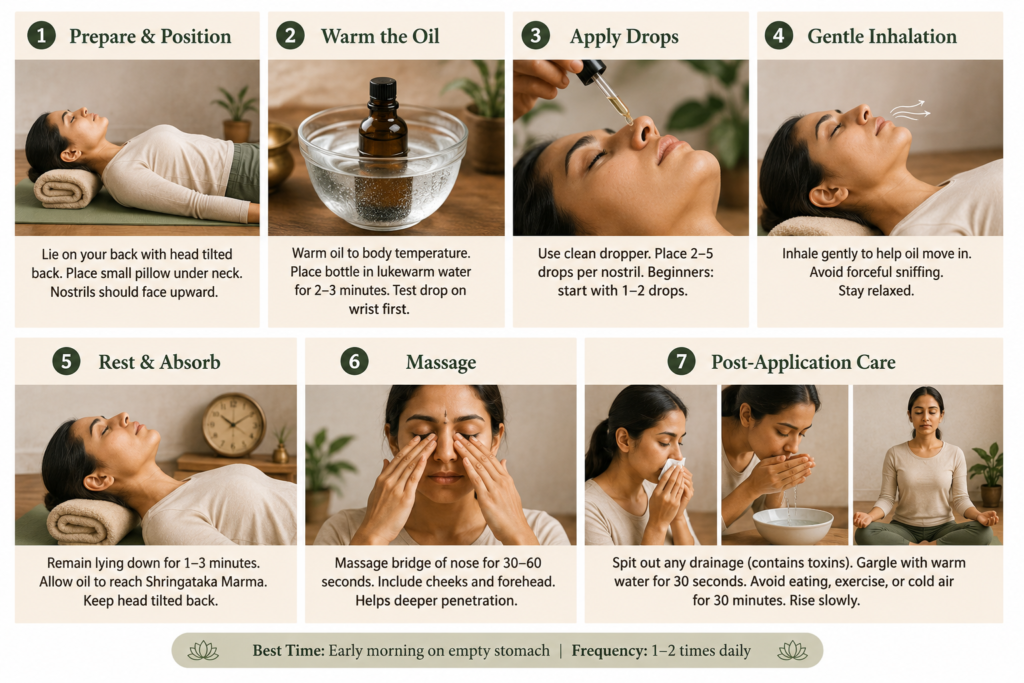
How to Apply Nasya (Step-by-Step)
The process itself is simple, but how it is done makes all the difference.
Begin by warming the oil slightly, bringing it to body temperature. This can be done by placing the bottle in warm water for a few minutes.
Lie comfortably on your back with a gentle tilt of the head, allowing the nostrils to open upward.
Place 2–5 drops of oil into each nostril, one at a time, and inhale softly—not forcefully, but just enough to allow the oil to move inward.
Remain still for a minute or two, allowing the oil to travel deeper into the tissues.
Then gently massage:
the sides of the nose
the cheeks
the forehead
This helps the oil distribute and absorb more effectively.
If any oil drains toward the throat, it is best to spit it out and rinse the mouth with warm water.
Afterward, give the body a little time. Avoid food, cold air, or activity for about 20–30 minutes.
Frequency: Daily vs. Deeper Practice
For most people, a daily gentle application (Pratimarsha Nasya) is more than enough.
This is not meant to be intense. It is meant to be consistent.
More intensive forms of Nasya do exist, using larger amounts of oil, but these are typically done under guidance and for specific conditions.
The daily version is simpler and often more sustainable.
How Nasya Fits Into the Bigger Picture
Nasya works best when it is not treated as an isolated technique.
It becomes far more powerful when it is part of a broader rhythm that includes:
regular meals
supportive digestion
steady sleep
moments of stillness
In that context, it is not just clearing the head.
It is helping maintain overall alignment between body, breath, and mind.
A Closing Reflection
The body does not need constant correction.
It responds best to small, consistent gestures that support what it is already trying to do.
Nasya is one of those gestures.
A few quiet moments in the morning.
A simple act of care.
A way to begin the day with clarity, rather than carrying forward what has already passed.
If this practice resonates, it often opens the door to a deeper understanding of how your body moves through clarity, digestion, and daily rhythm.
In Master Your Dosha, you’ll learn how your unique constitution shapes your energy, habits, and natural tendencies—so you can begin aligning your daily practices in a way that feels intuitive, supportive, and sustainable.