There is a kind of exhaustion that sleep alone does not fix.
You may get through the night, wake up, drink coffee, move through the day, and still feel mentally crowded, emotionally stretched thin, or unable to fully settle. Ayurveda has always understood this distinction. Rest is not simply the absence of activity. True rest is the body’s ability to release tension deeply enough that repair, digestion, emotional processing, and renewal can naturally happen.
This is where Yoga Nidra becomes so powerful.
Often translated as “yogic sleep,” Yoga Nidra is not actually sleep in the ordinary sense. It is a guided state between waking and sleeping where the body relaxes profoundly while awareness remains quietly awake. In Ayurveda, this state is considered deeply restorative because it allows the nervous system to shift out of survival mode and into healing.
For many people, especially those living with chronic overstimulation, Yoga Nidra becomes less about meditation and more about remembering what it feels like to truly let go.
What Is Yoga Nidra, Really?
Yoga Nidra exists in the liminal space between wakefulness and sleep — the threshold where the body softens but consciousness remains present. In this state, brain wave activity begins to slow into alpha and theta patterns, often associated with dreaming, creativity, memory integration, and nervous system recovery.
Unlike concentration-based meditation practices that ask the mind to focus intensely, Yoga Nidra works through effortless awareness.
You are not trying to control the mind.
You are learning to witness it.
A typical session gently guides awareness through the body, the breath, emotional sensations, and visual imagery. This process gradually withdraws energy from constant mental activity and redirects it inward, creating conditions where deep restoration can occur naturally.
Modern research continues to validate what yogic traditions have taught for centuries. Studies on Yoga Nidra have shown measurable reductions in stress, anxiety, rumination, and cortisol levels, while improving sleep quality and emotional regulation. Some researchers even refer to the practice as a form of “non-sleep deep rest” because of its ability to restore the nervous system without fully falling asleep.
Yet Ayurveda understood long ago that deep healing requires more than unconscious sleep.
It requires conscious rest.
Why Ayurveda Considers Rest a Pillar of Health
In Ayurveda, sleep — Nidra — is considered one of the three pillars of life alongside nourishment and wise energy management.
When sleep and rest become disturbed, every system of the body eventually feels the effects. Digestion weakens. Hormones become erratic. Emotional resilience decreases. The mind becomes reactive. Over time, this depletion begins accumulating as imbalance.
Yoga Nidra was traditionally used to help regulate this process by calming excess Vata in the nervous system.
Vata dosha governs movement, communication, thoughts, and the flow of nerve impulses throughout the body. When Vata becomes aggravated through overstimulation, irregular schedules, excessive screen exposure, stress, travel, or lack of grounding, the mind often struggles to slow down.
Many people experience this as:
racing thoughts before bed
light or interrupted sleep
anxiety and hypervigilance
emotional exhaustion
difficulty relaxing even during downtime
Yoga Nidra helps counter this by guiding the nervous system into a parasympathetic healing state where the body no longer feels the need to remain constantly alert.
In many ways, it teaches the body how to feel safe enough to rest again.
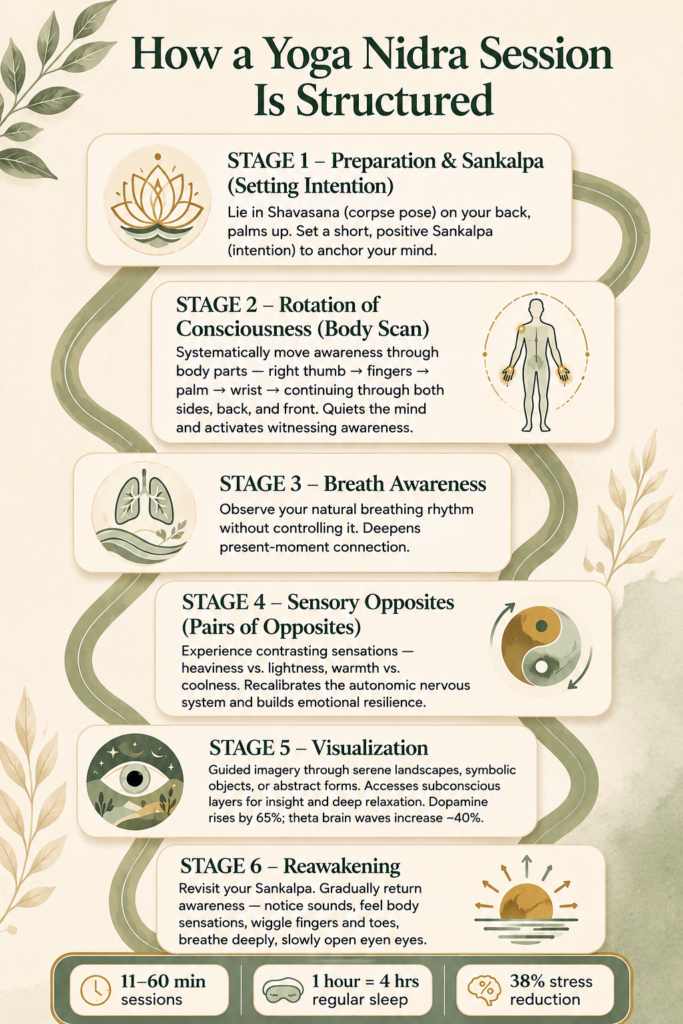
How a Yoga Nidra Session Is Structured
A Yoga Nidra session follows a gentle sequence designed to progressively relax the body and quiet mental activity. While different traditions may vary slightly, most sessions move through several foundational stages.
1. Preparation & Sankalpa
The practice begins lying comfortably in Shavasana, usually with the palms facing upward and the body fully supported with blankets or cushions if needed.
At the beginning of the session, you set a Sankalpa — a short, heartfelt intention stated positively in the present tense.
This is not simply positive thinking. In Yoga Nidra, the subconscious mind becomes more receptive, allowing intentions to settle more deeply beneath habitual mental patterns.
A Sankalpa may be something simple such as:
“I move through life with calm and clarity.”
“I trust myself.”
“I am grounded and supported.”
2. Rotation of Consciousness
Next comes a guided body scan where awareness systematically moves through different parts of the body in a precise sequence.
Rather than analyzing sensations, you simply notice each area as attention passes through it.
This stage helps interrupt repetitive mental loops while relaxing muscular and neurological tension stored throughout the body.
For many people, this is the moment where the nervous system finally begins softening.
3. Breath Awareness
Once the body becomes quiet, attention moves to the breath.
There is no attempt to control breathing. Instead, you observe the natural rhythm of inhalation and exhalation exactly as it is.
This stage deepens present-moment awareness while helping regulate the autonomic nervous system.
Often, the breath naturally slows on its own.
4. Sensory Opposites
In more traditional Yoga Nidra practices, you may be guided through opposite sensations such as:
heaviness and lightness
warmth and coolness
expansion and contraction
This stage helps build emotional resilience by teaching the nervous system to remain steady while experiencing changing sensations and states.
Rather than resisting discomfort or grasping for pleasantness, awareness becomes more spacious and less reactive.
5. Visualization
Guided imagery is then used to access deeper layers of the subconscious mind.
You may visualize landscapes, symbols, colors, nature scenes, or archetypal imagery designed to evoke emotional release and deep relaxation.
This phase often feels dreamlike yet strangely clear.
Many people describe it as deeply restorative even if they cannot fully explain why.
6. Reawakening
Toward the end of the session, awareness gradually returns to the body and surrounding environment.
You revisit your Sankalpa once more before gently deepening the breath, moving the fingers and toes, and slowly opening the eyes.
This transition matters.
Yoga Nidra is not meant to be rushed. Allowing the body a few quiet moments before immediately returning to stimulation helps preserve the nervous system benefits of the practice.
The Benefits of Yoga Nidra Go Beyond Relaxation
One of the reasons Yoga Nidra has remained relevant for thousands of years is that it supports the body on multiple levels simultaneously.
People often begin practicing because they feel stressed or exhausted.
But over time, many notice deeper shifts:
improved emotional regulation
clearer thinking
more stable energy
easier sleep
reduced anxiety
less reactivity
a greater sense of inner steadiness
Research has shown measurable reductions in stress markers after consistent practice, including lower cortisol levels and improvements in sleep efficiency.
But perhaps the greatest benefit is harder to measure scientifically.
Yoga Nidra helps people remember how to stop bracing against life.
For a nervous system accustomed to constant stimulation, that alone can feel transformative.
How to Begin Practicing Yoga Nidra
One of the beautiful things about Yoga Nidra is that it is accessible to almost everyone.
You do not need flexibility.
You do not need meditation experience.
You do not need to “clear your mind.”
You simply need a quiet space and a willingness to rest consciously.
For beginners, starting with short guided sessions of 10–20 minutes is often enough. Consistency matters more than duration.
Ayurveda traditionally recommends practicing in the evening before bed, especially during periods of stress, overstimulation, seasonal transition, or Vata imbalance.
To deepen the experience:
dim lights before practice
avoid screens beforehand if possible
keep the body warm and supported
practice on an empty or lightly filled stomach
allow quiet time afterward rather than immediately returning to stimulation
Over time, the body begins recognizing the practice as a signal for safety and restoration.
Deep Rest Is Not Laziness
Modern culture often glorifies productivity while quietly rewarding nervous system exhaustion.
Ayurveda takes a very different view.
Rest is not weakness.
Stillness is not wasted time.
Recovery is not separate from healing.
Yoga Nidra reminds us that the body already knows how to restore itself when given the right conditions.
Sometimes the deepest healing does not happen through effort.
Sometimes it begins the moment the body finally feels safe enough to let go.
Many people discover Yoga Nidra during stressful or exhausting periods, then realize it offers something deeper: a way to reconnect with the body’s natural rhythms.
In The Optimal Living Ayurveda Summit, experienced Ayurvedic teachers share practices for sleep, meditation, breath, and nervous system balance to help cultivate steadier energy, clarity, and calm from within.