Sound Healing in Ayurveda: How Naada Chikitsa Restores Emotional Balance
There are moments when words no longer help.
When the mind feels scattered, emotions feel heavy, or the nervous system refuses to settle, healing often begins somewhere deeper than thought.
In Ayurveda, sound is one of the oldest tools for restoring emotional balance.
Long before playlists, podcasts, and noise-canceling headphones, Vedic traditions understood that sound carries vibration — and vibration influences how we think, feel, and experience the world around us.
This ancient practice is known as Naada Chikitsa, the science of sound healing.
It is based on a simple yet profound understanding: when our inner rhythms become disturbed, intentional sound can help guide us back into harmony.
Whether through mantra, chanting, humming, music, or meditative listening, sound offers a gentle way to calm the mind, regulate the nervous system, and reconnect with ourselves.
The Ayurvedic Understanding of Sound
Ayurveda views human beings as expressions of nature.
Just as the seasons move in cycles and the tides rise and fall, the body and mind are constantly responding to subtle rhythms and vibrations.
The Vedic concept of Nada Brahma translates to “the universe is sound.”
Everything — from breath and heartbeat to thought and emotion — carries a vibrational quality.
When these internal rhythms become disrupted through stress, overstimulation, poor sleep, grief, or emotional strain, imbalance begins to appear.
Sometimes it shows up as anxiety.
Sometimes as irritability.
Sometimes as emotional heaviness or disconnection.
Sound becomes a way of restoring coherence.
Rather than forcing the mind to be still, it gives the mind something nourishing to rest upon.
Sound and the Three Doshas
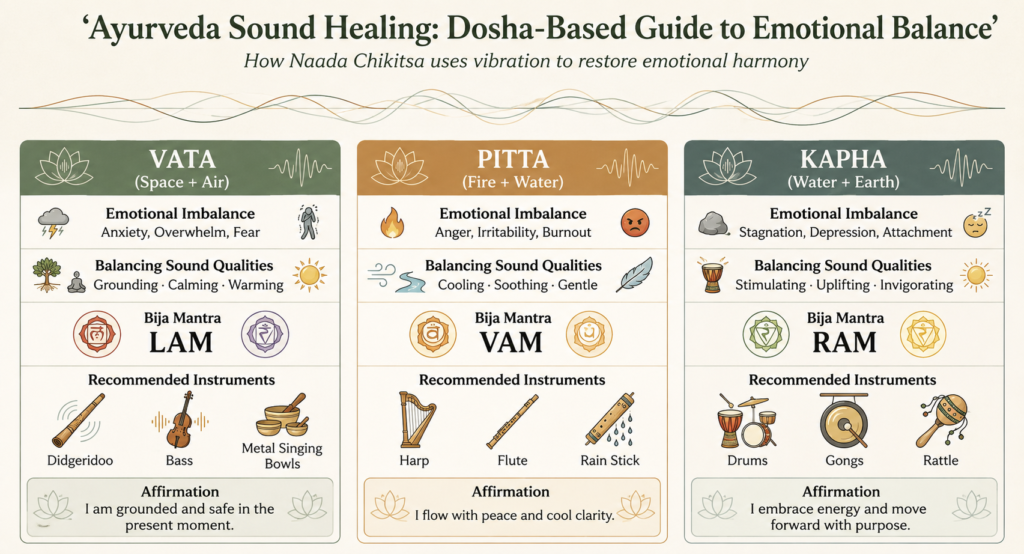
Ayurveda recognizes that emotional imbalances often reflect shifts in the doshas: Vata, Pitta, and Kapha.
Each dosha carries distinct qualities, and each responds to different types of sound.
The guiding principle is simple: balance comes through opposites.
Vata: Calming Anxiety and Overwhelm
Vata is made of space and air.
When out of balance, it can create fear, worry, racing thoughts, insomnia, and nervous system sensitivity.
To soothe excess Vata, choose sounds that feel:
Slow
Repetitive
Grounding
Warm
Deep
Helpful practices include:
Humming
Low-frequency instruments
Metal singing bowls
Gentle drumming
Repetitive mantra chanting
Bija mantra: LAM
Affirmation: I am grounded and safe in the present moment.
Pitta: Cooling Irritability and Intensity
Pitta is composed of fire and water.
When elevated, it can manifest as frustration, impatience, perfectionism, anger, or burnout.
Pitta benefits from sounds that are:
Cooling
Spacious
Gentle
Flowing
Heart-opening
Helpful practices include:
Soft flute music
Nature sounds
Chanting with a relaxed rhythm
Harp or string instruments
Guided meditations with soothing tones
Bija mantra: VAM
Affirmation: I flow with peace and clear awareness.
Kapha: Awakening Energy and Motivation
Kapha is made of earth and water.
When imbalanced, it can lead to lethargy, emotional stagnation, attachment, or low motivation.
Kapha responds well to sounds that feel:
Energizing
Uplifting
Rhythmic
Stimulating
Invigorating
Helpful practices include:
Drumming
Rhythmic music
Dynamic chanting
Percussion instruments
Group singing
Bija mantra: RAM
Affirmation: I embrace energy and move forward with purpose.
The Power of Mantra
The word mantra comes from two Sanskrit roots:
Manas — mind
Tra — tool or vehicle
A mantra is a sound that helps guide the mind toward steadiness.
Unlike affirmations, mantras are valued not only for their meaning but for their vibrational quality.
Through repetition, they help quiet mental noise and redirect awareness inward.
Traditionally, mantras are repeated using a mala with 108 beads, though even a few minutes of practice can have a calming effect.
You might begin by repeating a mantra aloud, then softly whispering it, and eventually allowing it to settle into silent awareness.
Over time, mantra practice can help cultivate emotional resilience, focus, and a greater sense of inner stability.
What Modern Research Says About Sound Healing
Ancient wisdom is increasingly being supported by modern science.
Research suggests that chanting, humming, and intentional sound practices may:
Reduce stress and anxiety
Lower cortisol levels
Improve sleep quality
Increase heart rate variability
Support emotional regulation
Activate the parasympathetic nervous system
Studies using brain imaging have found that repetitive sound practices can increase alpha and theta brainwave activity — states associated with relaxation, creativity, and meditation.
Humming also stimulates the vagus nerve, an important pathway involved in nervous system regulation.
This may explain why simple practices like chanting or humming often create an immediate sense of calm.
Sound does more than change how we feel in the moment.
With consistent practice, it can help retrain the nervous system to respond to stress with greater ease.
Simple Sound Practices You Can Try Today
You don’t need special equipment or extensive training to experience the benefits of sound healing.
Start with what feels accessible.
1. Humming for Nervous System Support
Sit comfortably and inhale through your nose.
As you exhale, create a soft humming sound.
Notice the vibration around your face, throat, and chest.
Continue for three to five minutes.
This simple practice can help settle mental restlessness and encourage deeper breathing.
2. Chant a Bija Mantra
Choose a mantra based on how you feel:
Feeling anxious? Chant LAM.
Feeling frustrated? Chant VAM.
Feeling sluggish? Chant RAM.
Repeat the sound slowly for one to three minutes.
Allow the vibration to be more important than perfect pronunciation.
3. Practice Intentional Listening
Choose music or sounds that support your current emotional needs.
This might include:
Nature sounds
Singing bowls
Flute music
Gentle drumming
Sacred chants
Close your eyes and listen without multitasking.
Allow the sound to become the object of your attention.
Even five minutes can shift your emotional state.
4. Begin and End the Day with Sound
Ayurveda teaches that daily rhythms shape our well-being.
Consider creating small rituals around sound:
Chant OM three times in the morning
Listen to calming music during your evening routine
Ring a bell before meditation
Hum softly before sleep
Consistency matters more than duration.
A few intentional minutes each day can create meaningful change over time.
A Gentle Reminder
Sound healing is not a replacement for professional medical or mental health care.
If you’re living with trauma, anxiety disorders, depression, or other health concerns, consider sound practices as a supportive complement to appropriate treatment.
Start slowly.
Notice how different sounds affect your body.
The goal is not stimulation or escape.
The goal is resonance.
Returning to Your Natural Rhythm
In a world filled with constant noise, intentional sound offers something increasingly rare: a way to listen.
To listen beneath the thoughts.
Beneath the tension.
Beneath the stories we carry.
Ayurveda reminds us that healing often begins by returning to what is already present within us.
Sometimes all it takes is a single sound.
A breath.
A mantra.
A moment of stillness.
And the willingness to tune back into the wisdom of your own inner rhythm.
Sound can calm the mind in the moment, but lasting emotional balance comes from supporting the whole system.
In The Optimal Living Ayurveda Summit, leading Ayurvedic teachers share practical tools for nervous system regulation, meditation, breathwork, sleep, and daily rhythms so you can cultivate greater calm, resilience, and well-being from within.