

When the Mind Affects the Body: Ayurveda's View of Chronic Disease
Modern medicine has made tremendous advances in understanding the body, yet many people living with chronic health challenges eventually discover that symptoms rarely exist in isolation.
Stress can aggravate digestive issues. Anxiety can disrupt sleep. Long periods of grief can affect energy, immunity, and overall vitality. Physical symptoms often create emotional strain, while emotional strain can worsen physical symptoms. Over time, the cycle can become difficult to untangle.
Ayurveda has recognized this relationship for thousands of years.
Rather than viewing the mind and body as separate systems, Ayurveda sees them as different expressions of the same intelligence. What affects one inevitably affects the other. This understanding forms the foundation of Ayurveda’s approach to chronic disease, where healing is not simply about reducing symptoms but restoring balance throughout the entire system.
When the mind becomes overwhelmed, the body responds. When the body becomes depleted, the mind responds as well. True healing begins when both are addressed together.
Ayurveda's Framework for Understanding Chronic Disease
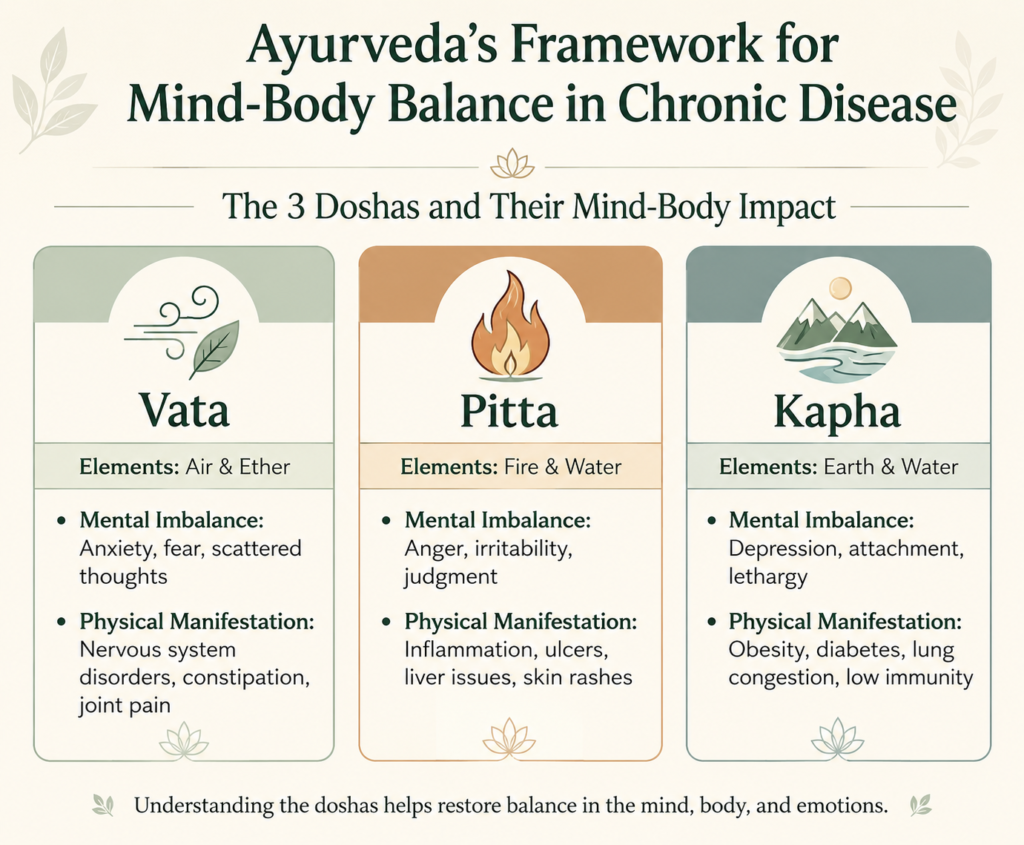
One of the reasons Ayurveda remains so relevant today is that it provides a practical framework for understanding how mental, emotional, and physical health continuously influence one another.
This framework is built around three essential concepts:
The Doshas, which govern physical and emotional tendencies
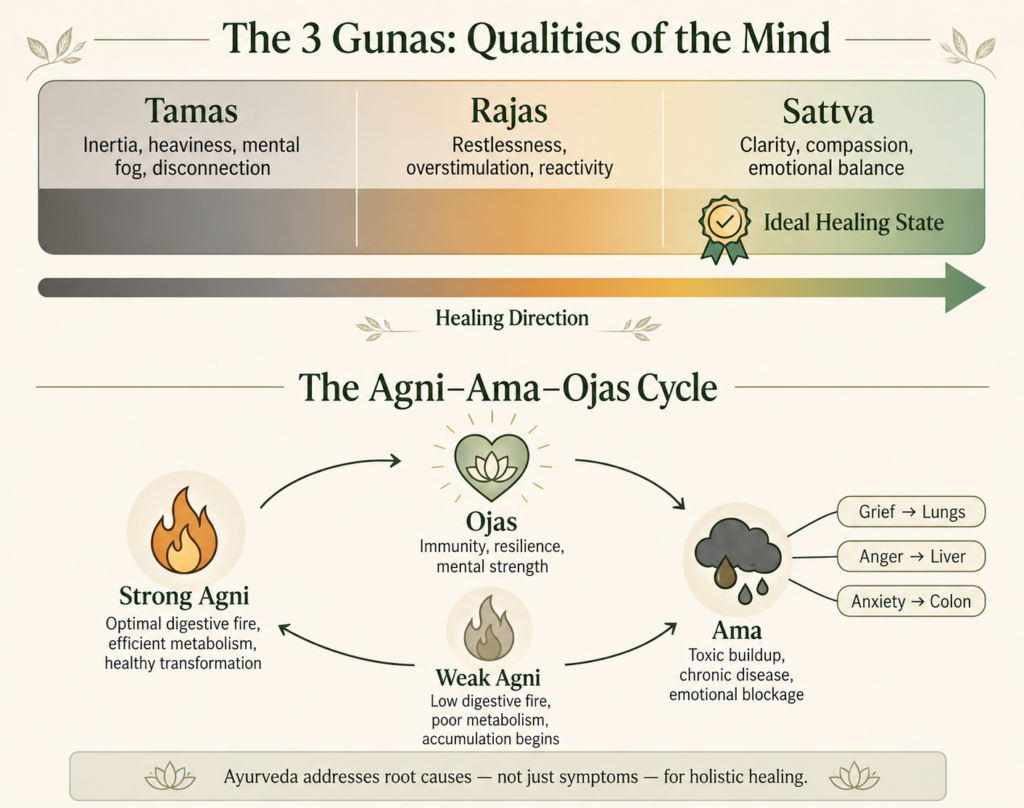
The Gunas, which describe the qualities of the mind
Agni, Ama, and Ojas, which explain how health, vitality, and disease develop over time
Together, these concepts help explain why chronic illness often involves more than physical symptoms alone.
The Three Doshas and Their Mind-Body Influence
According to Ayurveda, every person expresses a unique combination of Vata, Pitta, and Kapha. These biological forces influence everything from digestion and metabolism to emotional patterns and stress responses.
When balanced, the doshas support health and resilience. When aggravated over long periods of time, they can contribute to chronic physical and emotional challenges.
Vata: The Energy of Movement
Vata is composed of Air and Ether and governs movement within the body and mind.
When balanced, Vata supports creativity, adaptability, enthusiasm, and inspiration. When excessive, it often manifests as anxiety, fear, nervousness, overthinking, and scattered attention.
Over time, chronic Vata imbalance may contribute to:
Nervous system disorders
Constipation and digestive irregularity
Insomnia
Joint pain and degeneration
Chronic fatigue
Many modern stress-related conditions carry a strong Vata component because constant stimulation tends to destabilize the nervous system.
Pitta: The Energy of Transformation
Pitta is composed of Fire and Water and governs digestion, metabolism, ambition, and discernment.
Balanced Pitta supports intelligence, leadership, focus, and healthy motivation. When aggravated, it may show up as irritability, frustration, perfectionism, criticism, or anger.
Long-standing Pitta imbalance is often associated with:
Inflammatory conditions
Skin disorders
Liver congestion
Acid reflux
Autoimmune tendencies
Individuals with excess Pitta frequently push themselves beyond their limits, which can create a cycle of inflammation both physically and emotionally.
Kapha: The Energy of Structure and Stability
Kapha is composed of Earth and Water and provides nourishment, strength, and emotional steadiness.
When balanced, Kapha promotes compassion, patience, loyalty, and endurance. When excessive, it can lead to emotional stagnation, withdrawal, attachment, lethargy, and difficulty adapting to change.
Physical manifestations of chronic Kapha imbalance may include:
Weight gain
Metabolic disorders
Congestion
Low energy
Reduced immunity
While Kapha provides stability, too much of it can create heaviness in both the body and mind.
The Three Gunas: Understanding the Mind
While the doshas describe the body and its physiological tendencies, Ayurveda uses another framework to understand the mind itself.
These mental qualities are known as the Gunas.
Sattva: Clarity and Balance
Sattva represents harmony, wisdom, compassion, and emotional stability.
When Sattva is strong, the mind becomes clear, resilient, and capable of responding to life’s challenges without becoming overwhelmed by them.
In Ayurveda, Sattva is considered the ideal state for healing because it allows the body and mind to work together rather than against one another.
Rajas: Activity and Agitation
Rajas is the quality of movement, stimulation, and intensity.
In excess, it creates restlessness, impatience, worry, reactivity, and mental overactivity. Many people living with chronic stress spend large portions of their day in a Rajasic state without realizing it.
Tamas: Inertia and Heaviness
Tamas provides stability and rest when balanced. However, excessive Tamas can lead to mental fog, low motivation, emotional withdrawal, and feelings of disconnection.
Many chronic conditions involve fluctuations between Rajas and Tamas, with periods of overstimulation followed by exhaustion.
The goal of Ayurveda is not to eliminate these qualities entirely but to cultivate more Sattva so that clarity, resilience, and emotional balance can naturally emerge.
Agni, Ama, and Ojas: The Missing Piece Most People Never Learn
Perhaps one of Ayurveda’s most profound teachings is that we digest far more than food.
We also digest thoughts.
We digest emotions.
We digest experiences.
We digest life itself.
This process is governed by Agni, often translated as digestive fire.
Most people understand digestion as something that happens in the stomach. Ayurveda views digestion much more broadly. Agni influences how effectively we process not only what we eat, but also what we experience emotionally and mentally.
When Agni is strong, food is transformed into nourishment, experiences are processed effectively, and resilience naturally develops.
When Agni becomes weakened through poor habits, chronic stress, emotional overwhelm, or irregular routines, incomplete digestion occurs.
This creates Ama.
Ama is often described as toxic residue or metabolic waste. While physical Ama can arise from improperly digested food, Ayurveda also recognizes the existence of mental and emotional Ama.
Unprocessed grief.
Chronic resentment.
Suppressed anger.
Persistent fear.
Lingering emotional pain.
These experiences can remain within the system long after the original event has passed.
Over time, Ayurveda teaches that this accumulation contributes to imbalance throughout the body.
The opposite of Ama is Ojas.
Ojas is the refined essence of healthy digestion, balanced emotions, and strong vitality. It supports immunity, emotional resilience, mental clarity, and long-term well-being.
In simple terms:
Strong Agni creates Ojas.
Weak Agni creates Ama.
And over time, the accumulation of Ama becomes fertile ground for chronic disease.
Understanding this cycle shifts the conversation away from symptom management alone and toward cultivating the conditions that allow true healing to occur.
When Emotional Stress Becomes Physical
Most people have experienced the mind-body connection firsthand.
A stressful week may leave you with digestive discomfort. An argument can tighten the chest or create tension in the shoulders. Long periods of worry often disrupt sleep, appetite, and energy.
Ayurveda teaches that these are not separate events. The body is constantly responding to the state of the mind.
When emotions remain unresolved for weeks, months, or years, they can begin influencing physiological processes throughout the body. Stress hormones remain elevated, digestion becomes less efficient, sleep quality declines, inflammation increases, and the nervous system remains on high alert.
Over time, what began as emotional strain may contribute to physical symptoms.
This does not mean emotions are the sole cause of disease. Rather, Ayurveda recognizes that emotional health is one of the many factors that influence how illness develops, progresses, and heals.
For this reason, healing chronic disease is not only about supporting the body. It is also about creating conditions that support emotional balance, mental clarity, and nervous system regulation.
Five Ayurvedic Practices That Support Mind-Body Healing
One of Ayurveda’s greatest strengths is its practicality. Healing is not dependent on a single intervention. Instead, it emerges from the small daily habits that gradually restore balance over time.
1. Create Stability Through Daily Routine
Ayurveda places tremendous importance on Dinacharya, or daily routine.
When life feels unpredictable, routine provides stability for both the body and mind. Consistent wake times, meal times, and sleep schedules help regulate digestion, hormones, energy, and the nervous system.
A simple Ayurvedic morning routine may include:
Waking at a consistent time
Tongue scraping
Drinking warm water
Gentle movement or stretching
Five minutes of meditation or breath awareness
These practices may seem small, but their cumulative effect can be profound.
2. Use Breath to Calm the Nervous System
Breathing is one of the fastest ways to influence how we feel.
When stress rises, the breath often becomes shallow and rapid. When the breath slows, the nervous system receives a signal that it is safe to relax.
One of Ayurveda’s most recommended practices is Nadi Shodhana, or Alternate Nostril Breathing.
This simple technique helps balance the nervous system, quiet mental chatter, and reduce feelings of overwhelm.
Even five minutes per day can help create a greater sense of calm and emotional steadiness.
3. Let Food Become Part of the Healing Process
Ayurveda views food as one of the most powerful forms of daily medicine.
The goal is not to follow rigid dietary rules but to choose foods that support your unique constitution while strengthening Agni.
In general:
Vata benefits from warm, cooked, grounding meals.
Pitta benefits from cooling and hydrating foods.
Kapha benefits from lighter, warming meals and digestive spices.
Equally important is how you eat.
Eating slowly, avoiding distractions, and taking time to appreciate your meal can improve digestion and support a calmer state of mind.
After all, nourishment depends not only on what we eat but on how well we digest it.
4. Nourish the Nervous System With Abhyanga
Abhyanga, the Ayurvedic practice of self-massage with warm oil, is one of the simplest ways to support both emotional and physical well-being.
The gentle, rhythmic application of oil helps calm Vata, improve circulation, nourish the skin, and encourage relaxation.
Many people notice that regular Abhyanga helps them feel more grounded, centered, and resilient during periods of stress.
Even a ten-minute self-massage before a shower can become a powerful act of self-care.
5. Protect Your Energy Through Rest
Modern culture often celebrates productivity while undervaluing recovery.
Ayurveda takes the opposite view.
Sleep, rest, and restoration are considered essential pillars of health.
When the body is deprived of adequate rest, digestion weakens, emotional resilience decreases, and healing becomes more difficult.
Creating a consistent evening routine, reducing stimulation before bed, and prioritizing sleep may be among the most important steps someone with a chronic condition can take.
Rest is not a luxury.
It is part of the healing process.
Why Personalization Matters in Ayurveda
One of the reasons Ayurveda has endured for thousands of years is its recognition that no two people heal in exactly the same way.
Two individuals may share the same diagnosis while requiring entirely different approaches.
A person with a Vata imbalance may need warmth, grounding, and nervous system support.
Someone with excess Pitta may need cooling practices, emotional release, and reduced intensity.
A Kapha-dominant individual may benefit from more stimulation, movement, and lighter foods.
This is why Ayurveda focuses on understanding both your natural constitution (Prakriti) and your current state of imbalance (Vikriti).
Healing becomes more effective when recommendations are tailored to the individual rather than applied universally.
The Goal Is Not Perfect Health. It Is Greater Balance.
One of the most compassionate teachings in Ayurveda is that healing is not about fighting the body.
It is about listening to it.
Symptoms are often messages that something within the system requires attention. When we begin supporting digestion, calming the nervous system, processing emotions, and living more in harmony with our constitution, the body can redirect energy toward repair and restoration.
This does not happen overnight.
It happens through small choices repeated consistently.
A nourishing meal.
A few mindful breaths.
An earlier bedtime.
A daily walk.
A moment of stillness before reacting.
Over time, these practices help create the internal conditions that support resilience, vitality, and long-term well-being.
Ayurveda reminds us that true healing is not merely the absence of symptoms.
It is the experience of greater balance in the body, clarity in the mind, and steadiness in the heart.




Crystals for Vata Balance
Discover Ayurveda Beyond Symptom Management

Many people begin exploring Ayurveda to address a specific health concern, only to discover a deeper understanding of how the body, mind, and lifestyle work together.
In The Optimal Living Ayurveda Summit, leading Ayurvedic teachers share practical wisdom on digestion, stress, sleep, emotional well-being, and lasting vitality.
Recent Blog Post



© 2023 The Natural Law | Privacy Policy | Terms of Use