Yoga for Digestion: How Ayurveda Restores Your Body's Digestive Fire
There’s a particular kind of tiredness that shows up after a meal — heavy, foggy, and hard to shake, even when the food itself was good for you.
Sometimes it’s a tight, bloated stomach by mid-afternoon. Sometimes it’s an unpredictable morning, or a wave of sluggishness that no amount of coffee seems to touch.
Ayurveda has a name for what’s happening underneath all of this: agni, the body’s digestive fire.
When agni burns steadily, digestion tends to take care of itself — appetite feels regular, energy stays even, and elimination happens without much thought. When it weakens, the body lets you know in quieter ways, long before anything feels seriously wrong.
The good news is that agni responds well to rhythm. Not intensity, not more effort — rhythm. A little warmth in the morning, movement at the right moments, and a gentler pace around meals can do more for digestion than almost any single fix.
In this guide, you’ll discover:
what agni is, and how to recognize when it’s out of balance
the daily habits that protect your digestive fire
how stress and emotion factor into digestion, in Ayurveda’s view
yoga poses and breathing practices matched to specific digestive patterns
a simple daily rhythm you can start using today
Agni, Ama, and the Signs of Balance
In the Charaka Samhita, one of Ayurveda’s foundational texts, agni is described as the very root of health.
When agni is balanced, meals feel satisfying rather than heavy. Appetite stays steady. Energy holds through the afternoon. Elimination happens with ease, and the mind feels clear.
When agni weakens, food doesn’t fully break down. What’s left behind is called ama — a cold, sticky residue that Ayurveda describes as clogging the body’s channels. Ama can show up as fatigue, heaviness, gas, constipation, reflux, or a foggy, unfocused mind.
Modern life tends to chip away at agni in familiar ways: irregular mealtimes, eating on the go, long sedentary days, ultra-processed food, ice water with meals, grazing, and eating while distracted.
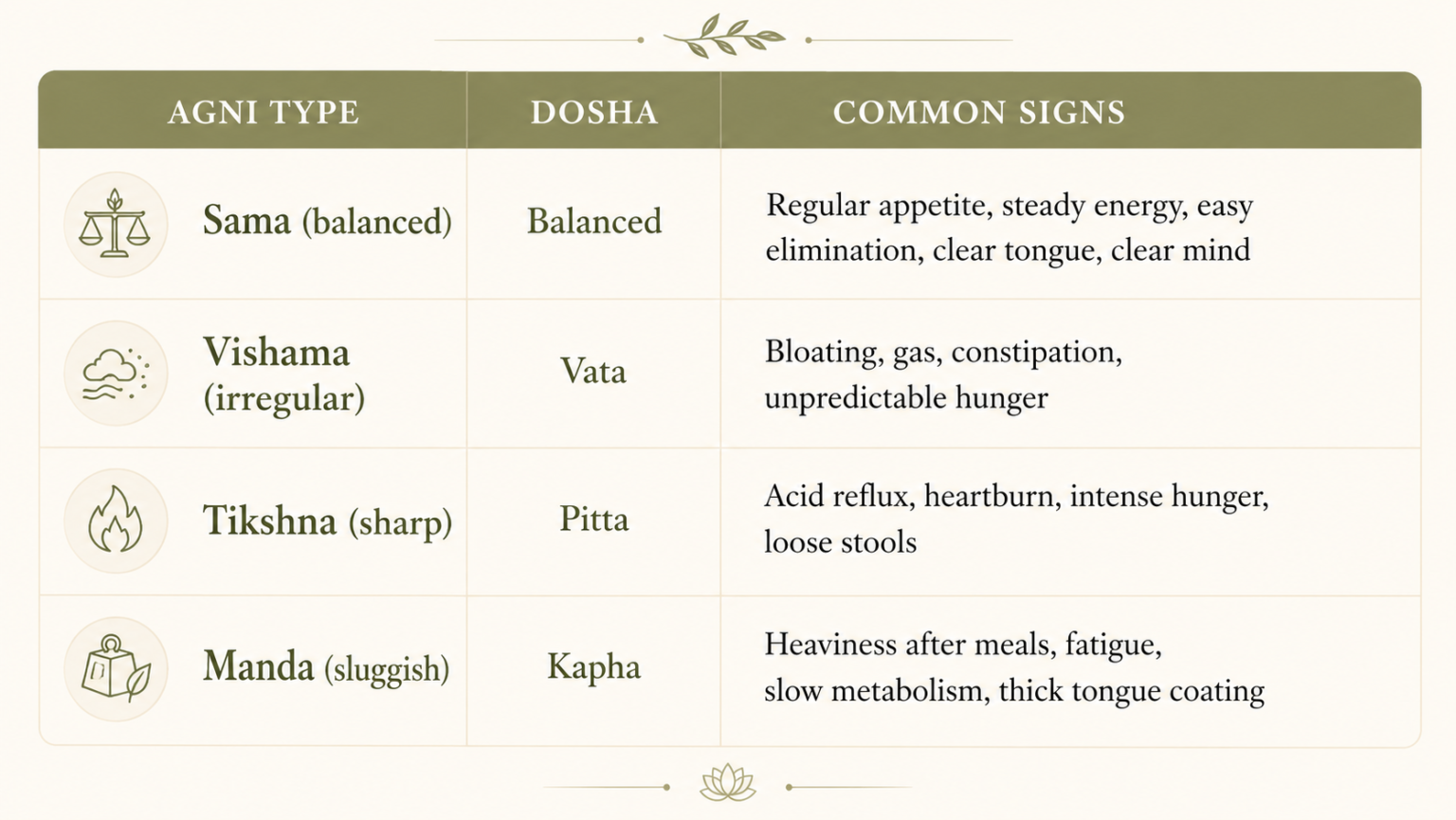
Ayurveda describes four states of agni, each tied to a different dosha and its own pattern of symptoms:
One of the simplest early clues is your tongue. A thick white, yellow, or gray coating in the morning can be a sign that ama has begun to build. Brain fog, foul-smelling or floating stools, and a heavy feeling upon waking often mean the imbalance has moved beyond the gut alone.
Once you recognize your pattern, daily rhythm is usually the fastest way back to balance.
Daily Habits That Protect Agni
Ayurveda considers midday — roughly 12:00 to 2:00 PM — the strongest window for digestion, which is why lunch works best as the largest meal of the day, with a lighter dinner to follow. A glass of warm water first thing in the morning can also gently support elimination.
A few small habits tend to make an outsized difference:
Favor warm, cooked meals over cold or raw ones
Season with digestive spices like ginger, cumin, black pepper, turmeric, cinnamon, or cloves
Eat slowly, without screens or distraction
Leave three to five hours between meals
None of these require an overhaul. Just a gentle return to rhythm.
How Stress and Emotion Shape Digestion
In Ayurveda, emotions are never separate from digestion — they’re part of the same process.
Stress can pull the nervous system away from the work of digesting, weakening agni in the process. Unprocessed stress, anger, or grief is thought to smolder rather than burn cleanly, and over time, that can contribute to ama building up in both the body and the mind.
This often shows up in familiar ways: unpredictable appetite, irregular elimination, abdominal discomfort, brain fog, or a shorter emotional fuse than usual.
This is exactly why breath and gentle movement matter so much when digestion feels off. They speak directly to the nervous system, not just the gut.
Why the Core Supports Digestion
The core is often thought of as just the abdominal muscles, but in this context, it’s a connected system — the abdominal wall, the diaphragm, the pelvic floor, and the deep muscles that run along the spine.
With every breath, the diaphragm rises and falls, gently massaging the abdominal organs and supporting gut motility through the vagus nerve. The pelvic floor, in turn, helps maintain healthy pressure and circulation through the lower abdomen.
Belly breathing helps these structures move as one. When breath drops fully into the lower ribs and belly, the diaphragm moves more freely and the pelvic floor can respond in kind — a small, steady rhythm that gives the abdomen a little more room to work.
Posture matters here too. Long hours of sitting and a slumped spine compress the abdomen, slowing circulation and motility. Gentle twists do the opposite — compressing the digestive organs and then releasing them, encouraging blood flow as you unwind. A little more space in the spine tends to translate to a little more ease in the gut.
Yoga Practices Matched to Your Digestive Pattern
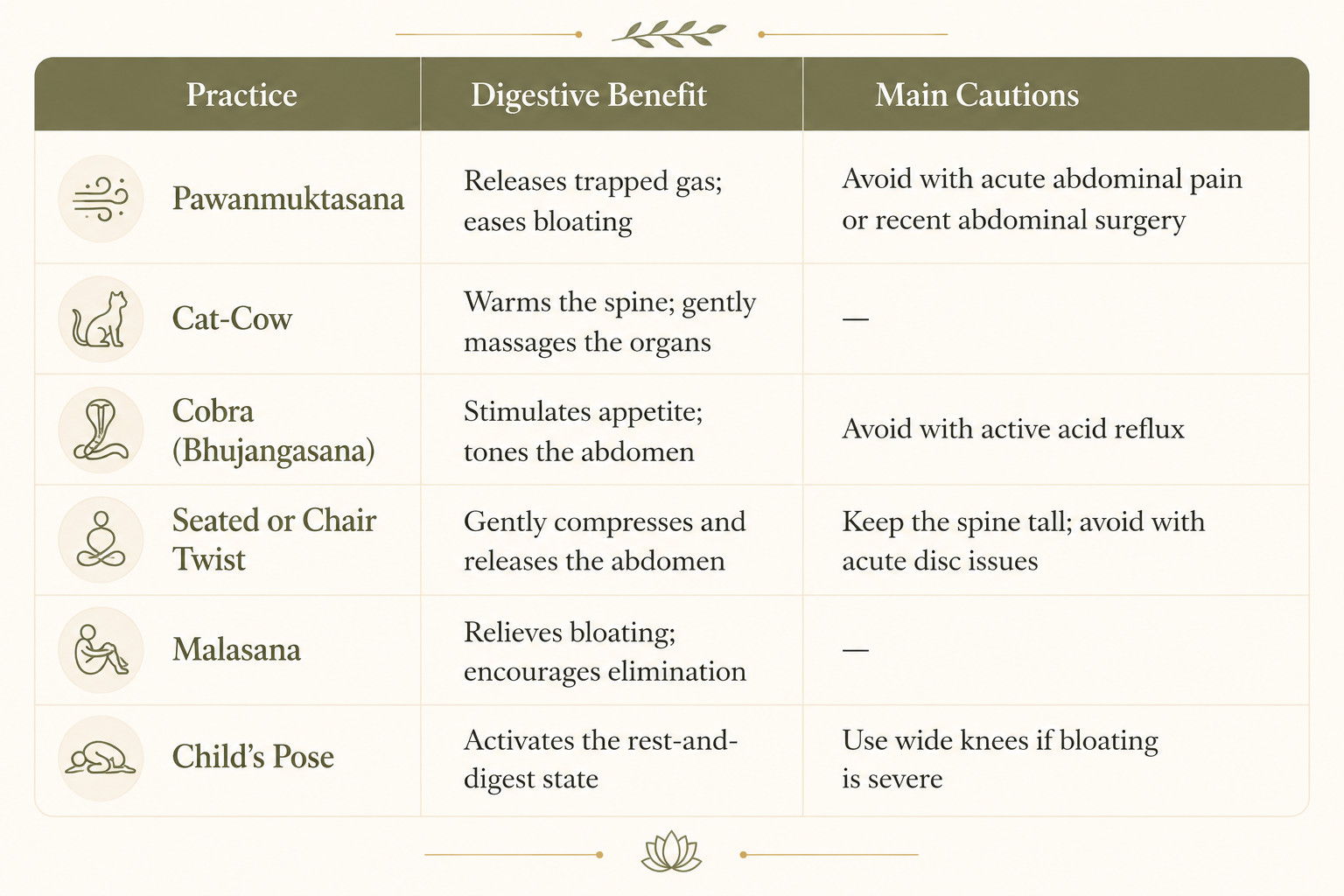
The most effective approach isn’t more yoga. It’s the right yoga for what your body is doing that day. Stimulating practices help sluggish digestion. Cooling, gentle practices ease heat and inflammation. Soft, restorative shapes support a stressed or sensitive gut.
As a general rule, practice on an empty stomach or wait two to three hours after eating. Vajrasana is the one exception — it’s safe, and even helpful, right after a meal, easing pressure and heaviness.
Breathwork to Stimulate or Calm Digestion
Choose your breath practice the way you’d choose a pose — based on what your body needs in the moment. Heat-building breath like Kapalabhati can help with Kapha sluggishness. Balancing breath like Nadi Shodhana eases Vata-driven stress. Cooling breath like Shitali or Sitkari helps when excess heat or inflammation is the issue.
Go gently here. Breath retention and forceful practice can increase abdominal pressure and discomfort, so it’s best to keep things soft, and to only explore deeper cleansing techniques under the guidance of an experienced teacher.
Whenever you practice a more stimulating breath, let it be followed by something slower and quieter.
Restorative Practice, Meal Timing, and Consistency
When digestion feels irritated, the instinct might be to push harder. Ayurveda suggests the opposite: back off instead of adding intensity.
Stronger practices — Boat Pose, deeper twists, more stimulating breathwork — fit best in the morning, well before a meal, when agni is being kindled rather than asked to do the work of digesting. After lunch, a slow ten-minute walk supports digestion far more than a workout would.
The gut tends to respond best once the nervous system settles. That parasympathetic shift is what allows digestion to do its job well. Restorative shapes like Child’s Pose, paired with slow diaphragmatic breathing, offer a gentle way to get there.
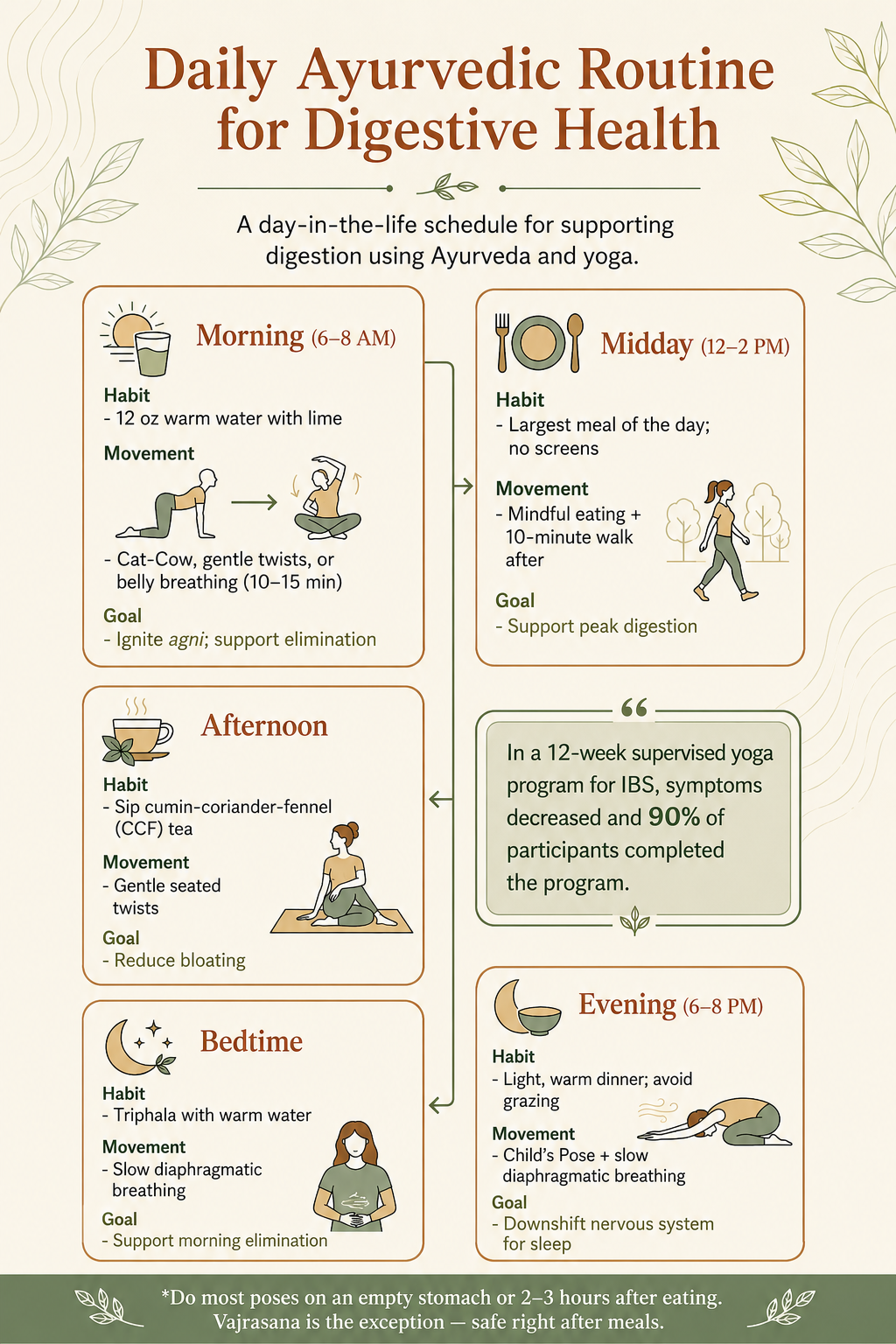
In one twelve-week, supervised yoga program for IBS, symptom severity eased significantly, and 90% of participants stayed with the practice through to the end.
Small, steady habits outperform hard effort here. Consistency is the practice.
A Simple Ayurvedic Day for Digestive Support
Once you recognize your pattern, the next step is simply rhythm.
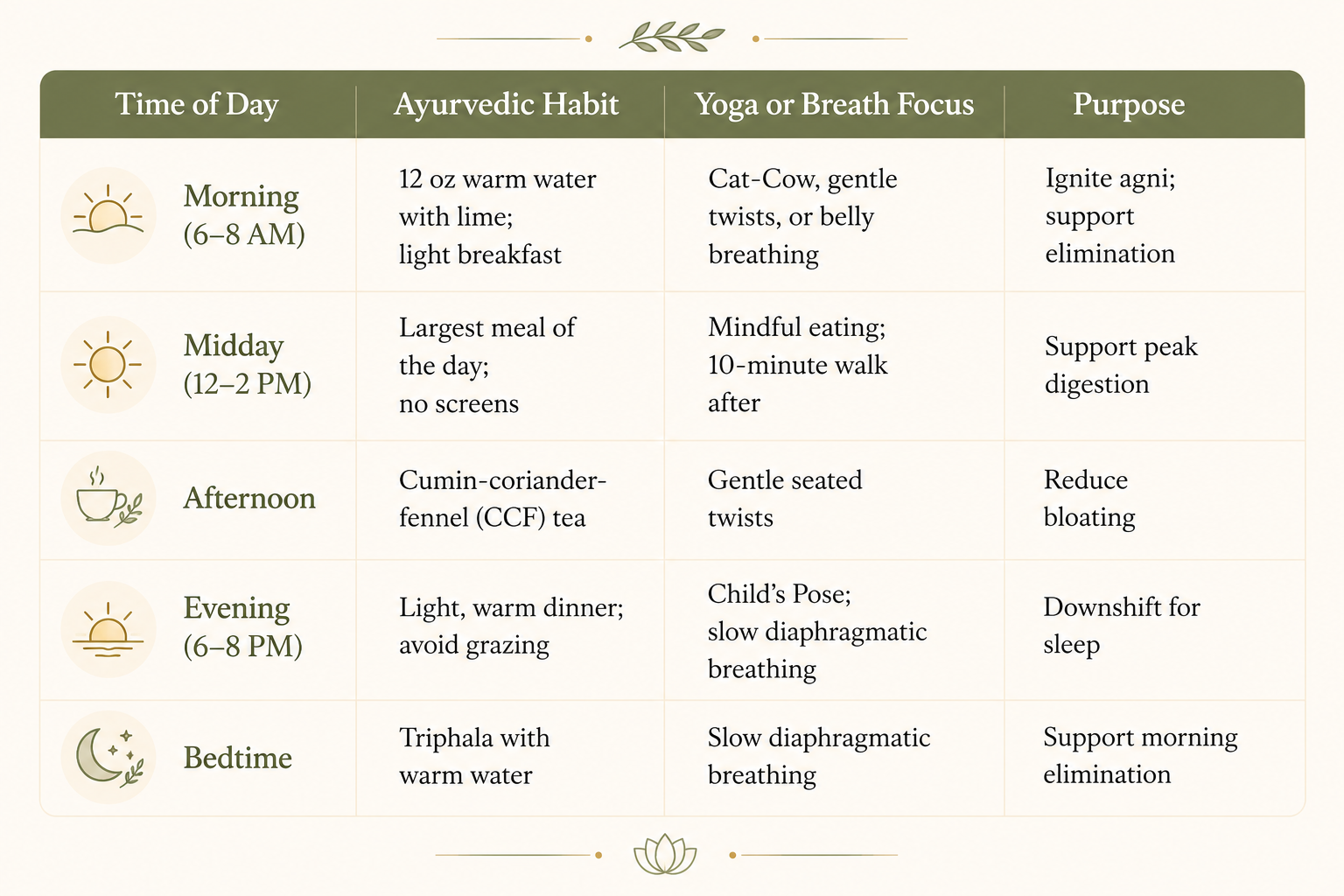
Start the morning with 12 ounces of warm water and lime to support hydration and elimination, followed by ten to fifteen minutes of Cat-Cow, gentle twists, or belly breathing to spark agni. At midday, make lunch your largest meal, and take a ten-minute walk afterward. In the afternoon, a cup of cumin-coriander-fennel tea can ease bloating. By evening, shift into a lighter dinner, Child’s Pose, and slow diaphragmatic breathing to help the body downshift toward sleep. Triphala with warm water before bed is a traditional way to support elimination the next morning.
Treat this as a gentle template, not a rigid schedule.
Adjusting for Reflux, IBS, Inflammation, and Low Mobility
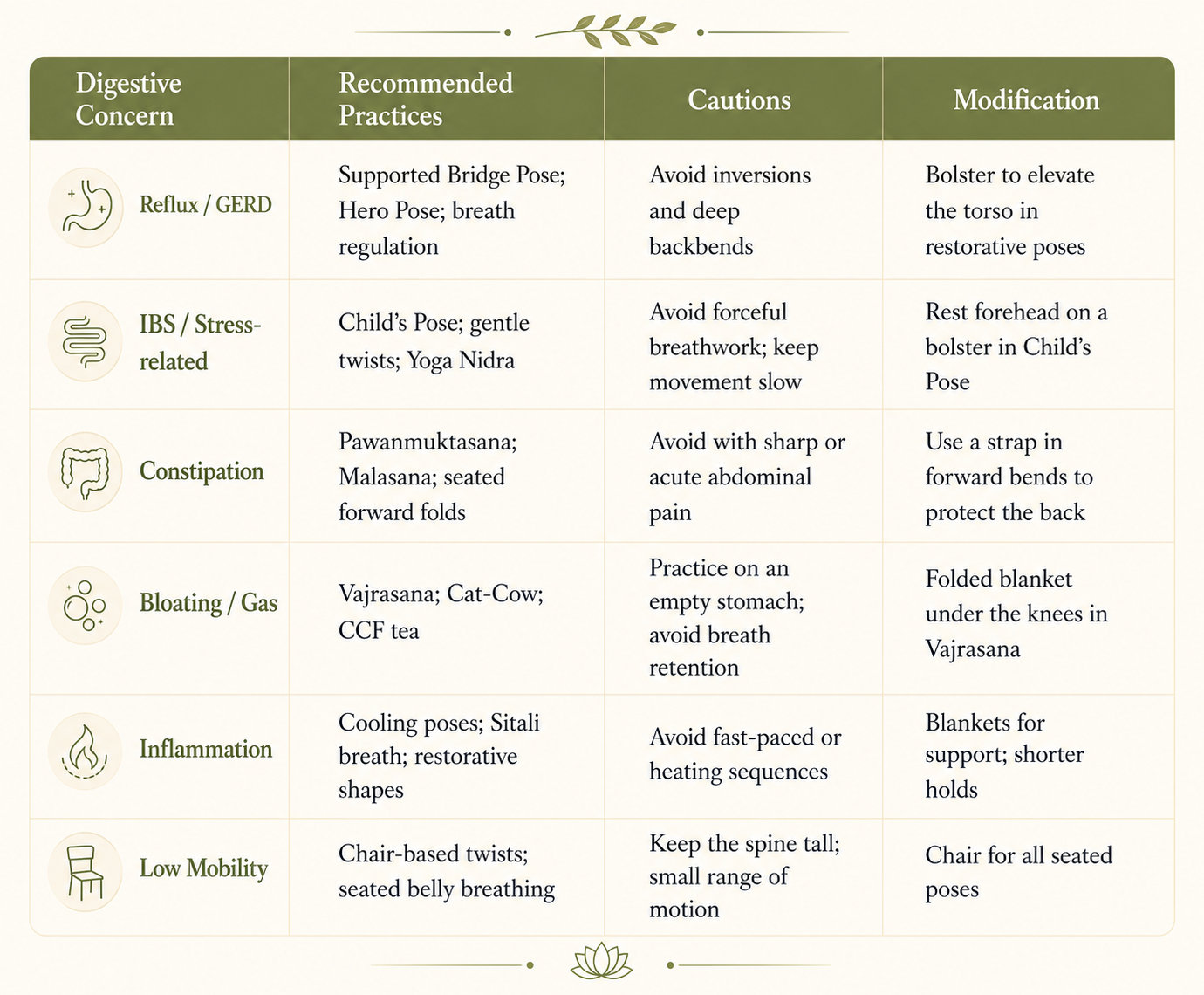
When symptoms flare, the practice should soften to meet them. Skip vigorous yoga, deep forward folds right after meals, and forceful breathwork whenever things feel active or irritated.
For reflux or GERD, stay upright for thirty to sixty minutes after eating and set aside inversions or deep backbends for another time. For IBS or stress-related flares, prioritize settling the nervous system: Yoga Nidra and slow diaphragmatic breathing tend to help more than dynamic movement. If inflammation is the concern, keep things cooling and restorative with Sitali breath and gentle shapes. For low mobility, chair-based twists and seated belly breathing offer real support without requiring any floor work at all.
Returning to Rhythm
Digestive health, in Ayurveda’s view, was never meant to be built through force.
It’s built through rhythm. Protecting agni. Giving the core room to do its quiet work. Matching the intensity of your practice to what your body is actually asking for on any given day.
A warm glass of water. A few minutes of movement. A slower lunch. An evening that winds down instead of rushing forward.
None of it is dramatic. All of it adds up.
Research suggests that even four to six weeks of steady practice can bring measurable improvement to gut motility and stress-related symptoms — proof that the smallest, most repeatable habits are often the ones that change the most.
Start small. Stay consistent. Let the rhythm do the rest.
This guide offers a starting rhythm, but if your gut needs a deeper reset, the 10-Day Ayurvedic Detox Journey walks you through Ayurveda’s three-part approach to purification, dosha balancing, and rejuvenation, supporting everything from your digestion to your mental clarity and energy.