The Night Reset: How Ayurveda Restores Balance Through Sleep
There’s a moment at night, subtle, easy to miss, when the body begins to shift inward.
The day loosens its grip.
The mind softens.
And something deeper begins to take over.
In Ayurveda, this transition is not incidental. It is essential.
Sleep, or Nidra, is considered one of the three pillars of health — alongside nourishment and the wise use of energy. But more than rest, it is a process of repair, integration, and quiet intelligence.
What we cannot process during the day… the body completes at night.
How Ayurveda Understands Sleep
In classical Ayurveda, sleep is not simply about duration.
It shapes:
how the body rebuilds
how the mind processes experience
how vitality, Ojas, is restored
There is a beautiful line in the ancient texts that says:
Happiness and unhappiness, strength and weakness, clarity and confusion… all depend on sleep.
Which means:
Sleep is not separate from health.
It is the foundation of it.
The Body Follows a Rhythm
One of the most overlooked aspects of sleep is timing.
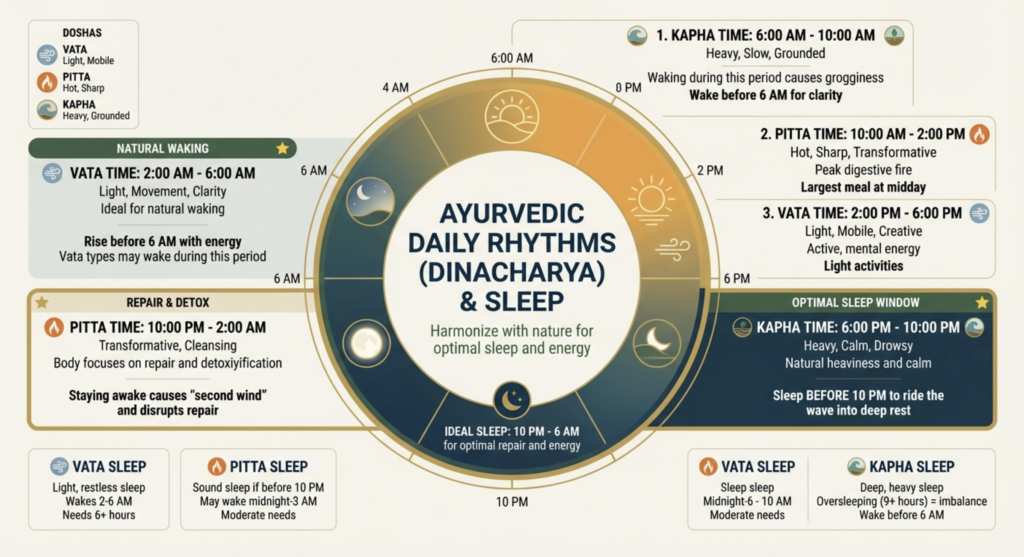
Ayurveda describes the day and night as moving through repeating cycles of the doshas — each carrying a different quality.
Evening: The Kapha Window (6 PM – 10 PM)
This is the body’s natural descent.
Heaviness begins to settle.
The senses start to withdraw.
The body prepares for rest — if we allow it.
If you follow this rhythm and go to bed before 10 PM, sleep tends to come more easily, more deeply.
If you miss it, something interesting happens.
Night: The Pitta Window (10 PM – 2 AM)
Instead of resting, the body becomes active again — but inwardly.
This is when:
repair happens
digestion completes
subtle cleansing begins
If you’re asleep, this process supports you.
If you’re awake, that same energy turns outward — often as a second wind.
More alertness.
More thinking.
Less rest.
Early Morning: The Vata Window (2 AM – 6 AM)
This is the lightest part of the night.
Dreaming becomes more active.
The mind becomes more subtle.
And just before sunrise, there’s a natural clarity available — one that Ayurveda encourages us to wake into.
Why You May Not Feel Rested
Sometimes, sleep happens… but restoration doesn’t.
In Ayurveda, this often relates back to what we explored last week — what hasn’t been fully processed.
If digestion is incomplete,
if the mind is overstimulated,
or if the body is out of rhythm…
then the night becomes less about repair, and more about catching up.
This is why sleep is not just about what happens during the night.
It’s shaped by what happens before it.
Preparing the Body for Rest
The hours leading into sleep matter more than most people realize.
Ayurveda sees this time as a gradual unwinding — a soft transition from outward activity to inward restoration.
A few simple shifts can make a profound difference:
Let the lights dim naturally in the evening
Step away from screens earlier than feels necessary
Eat in a way that feels light, warm, and complete
Allow a little space between dinner and sleep
Even something as simple as a short walk after a meal can signal to the body that the day is closing.
And then… small rituals begin to matter.
A warm foot massage.
A quiet moment of stillness.
A few slow breaths.
Not as techniques — but as signals.
The body listens.
Food and Sleep Are Not Separate
One of the simplest, most overlooked truths:
How you eat affects how you sleep.
A heavy or late meal doesn’t just sit in the stomach — it asks the body to stay active when it should be resting.
A lighter, earlier meal allows digestion to complete before sleep begins.
This is why Ayurveda gently suggests:
eating earlier in the evening
choosing warm, easy-to-digest foods
avoiding overstimulation late in the day
Even a warm drink before bed — something simple, like spiced milk or herbal tea — can signal the body to soften.
Sleep Looks Different for Everyone
Not all sleep is the same.
Each constitution carries its own tendencies:
Vata may feel light, easily disturbed, or restless
Pitta may sleep deeply but wake in the middle of the night
Kapha may sleep heavily, sometimes too much
The goal is not to force a perfect routine.
It’s to understand your nature — and support it gently.
Over Time, Rhythm Becomes Natural
One of the most reassuring aspects of Ayurveda is this:
Nothing needs to change all at once.
Sleep improves through consistency, not intensity.
Going to bed a little earlier.
Eating a little lighter.
Creating a small moment of quiet before sleep.
These are not dramatic changes.
But over time, they restore something deeper:
rhythm.
And when rhythm returns, the body doesn’t need to be told how to rest.
It remembers.
A Final Thought
Sleep is not something we force.
It’s something we allow.
And often, what we’re really doing is not trying to sleep better…
but learning how to let the day complete itself.
When that happens, rest is no longer something you chase.
It’s something that comes, quietly and naturally, on its own.
Sometimes, better rest begins with a deeper understanding of how your body moves through energy, digestion, and renewal.
In The Optimal Living Ayurveda Summit, you’ll learn from leading Ayurvedic teachers on how to align with natural rhythms — supporting clearer days, calmer evenings, and more restorative nights.