The Hidden Weight: Understanding Ama, Ayurveda’s Root of Imbalance
There are times when the body doesn’t feel unwell in any obvious way, and yet something feels slightly off.
It’s not something you can easily point to or name. You’re not sick, and nothing feels urgent enough to fix, but there is a subtle heaviness that wasn’t there before. Digestion feels slower, energy is harder to access, and even your thoughts can feel a little less clear than usual.
In Ayurveda, this experience is not vague or incidental. It is understood very clearly, and it has a name: Ama.
What Is Ama, Really?
Ama is often translated as “toxins,” but this can be misleading if we think of it only in terms of external substances. In Ayurveda, Ama refers more precisely to what the body has not been able to fully digest or process, whether that comes from food, experience, or even emotion.
This process begins in the gut, where digestion is governed by Agni, the digestive fire. When Agni is strong, food is efficiently transformed into nourishment. But when it is weakened, even slightly, digestion becomes incomplete, and what remains begins to accumulate.
Over time, this accumulation becomes Ama.
The Qualities of Ama
Classical Ayurvedic texts describe Ama not just by what it is, but by how it behaves in the body. It tends to have certain qualities that make it particularly disruptive to normal function.
Ama is typically:
Heavy and dense, which causes it to settle rather than move
Sticky in nature, allowing it to adhere to tissues and channels
Slow and obstructive, interfering with circulation and elimination
Dull or cloudy, diminishing clarity both physically and mentally
Because of these qualities, Ama does not move easily through the body. Instead, it tends to accumulate and gradually block the natural pathways through which nutrients are delivered and waste is removed.
How Ama Forms
Ama does not appear suddenly. It develops over time, often through patterns that feel completely normal in modern life but slowly weaken digestion.
Some of the most common contributors include:
Eating before the previous meal has fully digested, which overloads the system
Overeating, even when the food itself is considered healthy
Combining foods that are difficult for the body to process together
Eating while distracted, rushed, or emotionally unsettled
In addition to diet, lifestyle plays a significant role. Chronic stress, irregular routines, and constant stimulation can all weaken Agni, making it more difficult for the body to fully process what it takes in.
When digestion becomes inconsistent in this way, Ama begins to form quietly in the background.
How Ama Affects the Body
Once Ama forms, it does not remain confined to the digestive system. It begins to circulate through the body, interacting with the doshas — Vata, Pitta, and Kapha — and settling in different areas depending on individual tendencies.
This is why Ama can express itself in many different ways, including:
Digestive discomfort, such as bloating, heaviness, or irregular appetite
Joint stiffness or discomfort, especially when combined with Vata imbalance
Mental fog or reduced clarity, affecting focus and motivation
Persistent fatigue, even when rest is adequate
Although these symptoms may seem unrelated, Ayurveda understands them as different expressions of the same underlying accumulation.
A Bridge to Modern Science
Modern research is beginning to observe similar patterns through a different framework, particularly in the study of gut health and systemic inflammation.
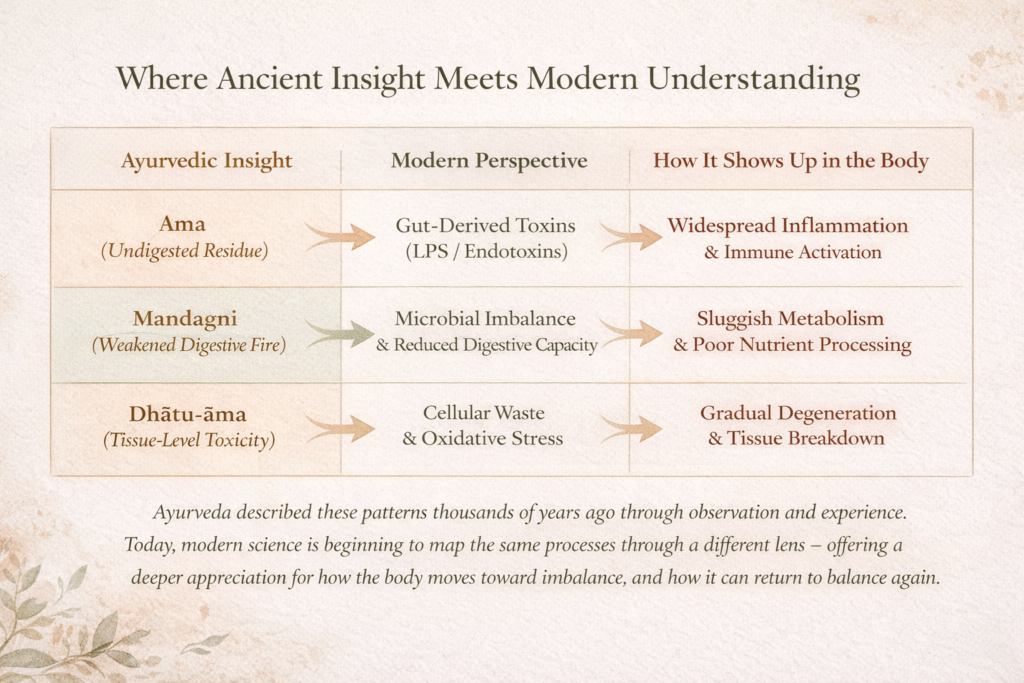
Substances like lipopolysaccharides (LPS), which are toxins produced by certain gut bacteria, can enter the bloodstream when digestion is impaired and the gut lining becomes more permeable. Once in circulation, these compounds are associated with:
chronic inflammation
metabolic dysfunction
changes in mood and cognitive function
In Ayurveda, this would be described as Ama moving beyond the digestive system and affecting deeper tissues.
Different language, but a remarkably similar understanding.
To make this connection clearer, it can help to see these parallels side by side:
When Ama Moves Deeper
If Ama is not addressed early, it does not simply remain at the surface level. Over time, it begins to penetrate deeper into the body’s tissues, a stage referred to as Dhātu-āma.
At this level, the body’s ability to repair, regenerate, and maintain balance becomes more compromised. What began as a subtle digestive imbalance can gradually evolve into more persistent and chronic patterns.
This is why early awareness is so important.
Recognizing Early Signs of Ama
The body rarely moves straight into imbalance without offering signals along the way. These signs are often subtle, but they are consistent.
You may notice:
a thick coating on the tongue in the morning
a lingering sense of heaviness after meals
reduced or irregular appetite
low energy, particularly after eating
a general sense of dullness or lack of clarity
These are not problems to fear, but signals worth paying attention to.
Supporting the Body, Gently
Ayurveda does not approach Ama with force or urgency. Instead, it focuses on restoring the body’s natural ability to digest, process, and eliminate.
This begins with simple, sustainable shifts:
Choosing meals that are warm, freshly prepared, and easier to digest
Eating at regular times, allowing digestion to complete before the next meal
Drinking warm water instead of cold, which supports digestive fire
Creating a calm, undistracted environment while eating
Over time, these practices help rebuild Agni. As digestion strengthens, the body naturally begins to clear what it has been holding onto.
A Different Way of Looking at Health
What Ayurveda offers is not just a set of practices, but a different way of understanding the body.
Health is not something that shifts suddenly. It changes gradually, through patterns, habits, and what is either processed or left behind.
Ama is simply a reflection of what has not yet been fully digested.
A Final Reflection
Not everything that weighs us down is obvious.
Sometimes it is something subtle, something that builds slowly over time — a heaviness that lingers, a lack of clarity that is difficult to explain, or a sense that something has not fully moved through.
Ayurveda gives us a way to understand that, not as something to fear, but as something to notice.
Because when we notice early, the body does not need to speak loudly.
And returning to balance becomes something gentle, steady, and entirely possible.
In Ayurveda, healing begins with understanding your unique nature. In Master Your Dosha, you’ll explore how your constitution shapes digestion, energy, and balance—so you can make choices that truly support your body. Through timeless guidance, you’ll learn how to live in alignment with your nature, not against it.